Thumb CMC arthroplasty is surgery for arthritis at the base of the thumb. It removes or reshapes the worn joint and rebuilds support so the thumb moves without the bone-on-bone pain. It is offered when pain and weakness do not improve with non-surgical care. Recovery is gradual over several months.
Jeff Cole performs thumb cmc (basal joint) arthroplasty in Memphis when it is the right step, and reviews every alternative with you first.
What is Thumb CMC (Basal Joint) Arthroplasty?
The base of the thumb has a joint called the carpometacarpal joint, often shortened to CMC joint and also called the basal joint.
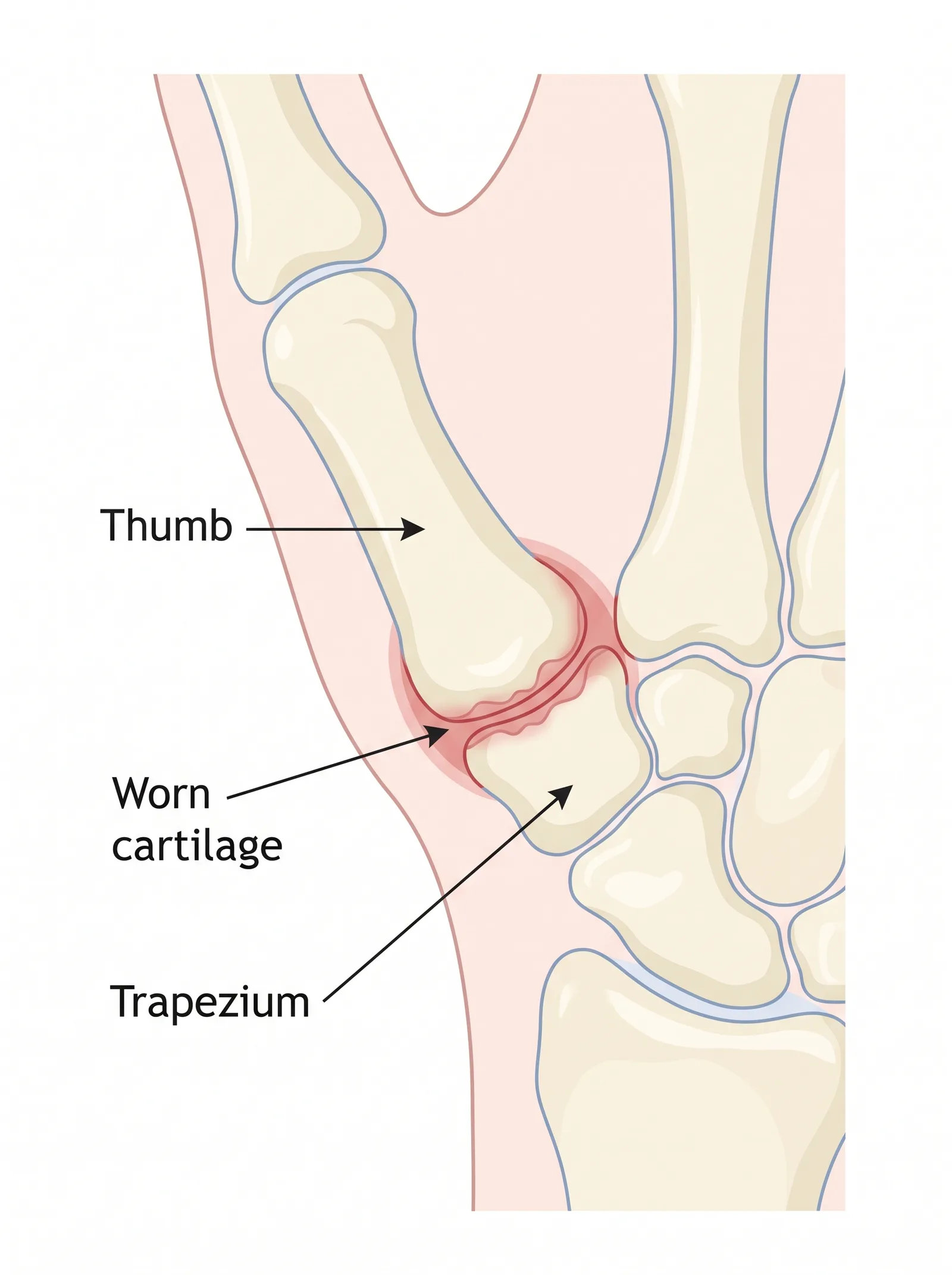
It sits where the thumb meets the wrist. This joint is shaped like a saddle, which lets the thumb move in many directions and pinch and grip. Because it works so hard, it is a common place for arthritis.
Arthritis means the smooth cartilage that caps the ends of the bones wears away. Cartilage is the slick cushion that lets bones glide. When it wears down at the thumb base, the bones rub together, which causes pain, swelling, and weakness. Over time the joint can become loose or shift, and the base of the thumb may look larger or more prominent.
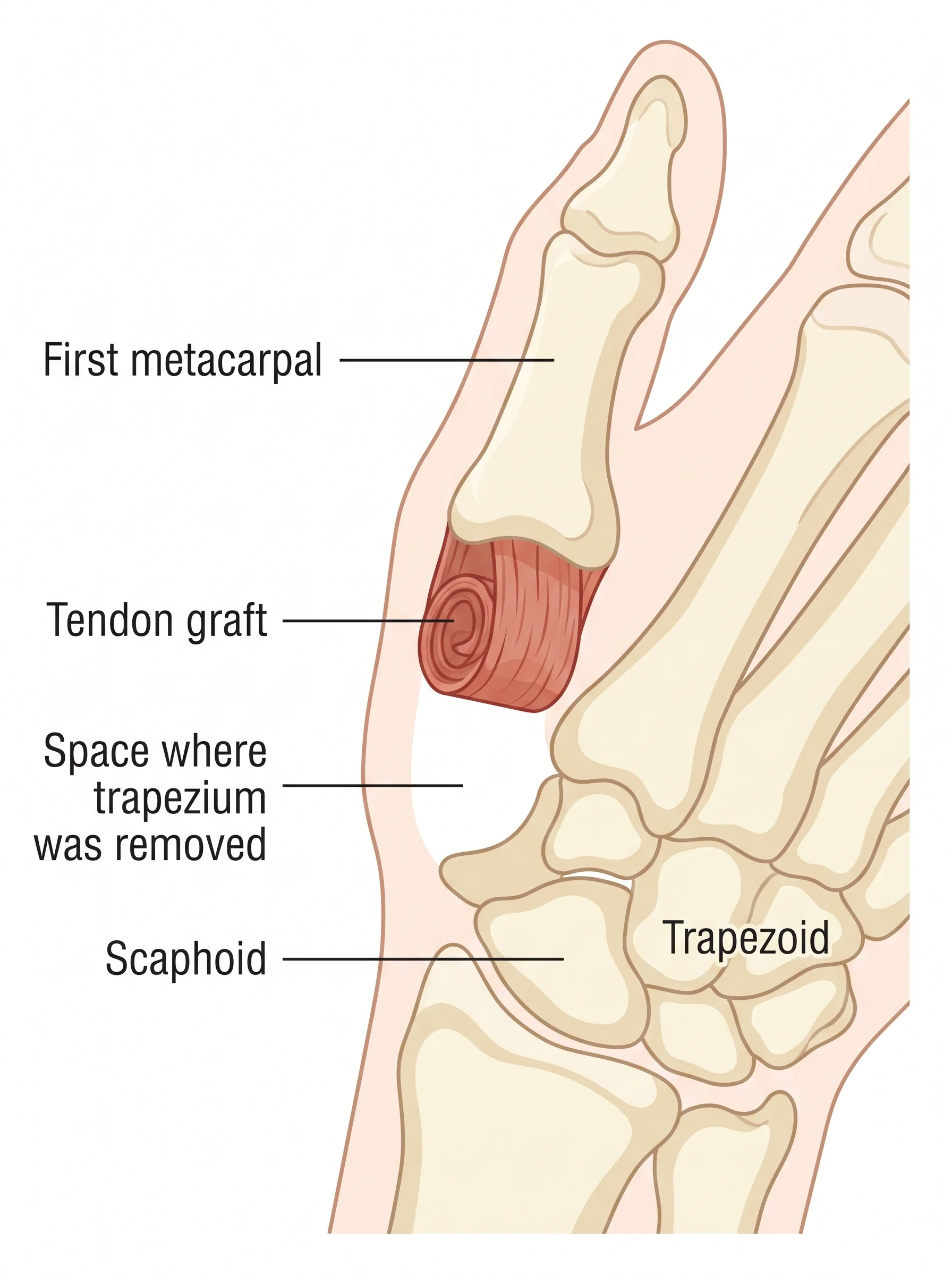
Thumb CMC arthroplasty is surgery to treat this worn joint. "Arthroplasty" means rebuilding or reshaping a joint. There are several ways to do it. A common approach removes the small wrist bone called the trapezium, which forms one side of the worn joint, so the bones no longer grind. This is called a trapeziectomy. Surgeons often add a step to fill and stabilize the space, sometimes using one of your own nearby tendons to create a soft cushion and a sling that supports the thumb. This combined approach is often called ligament reconstruction and tendon interposition, shortened to LRTI. Other techniques exist, including different ways to suspend the thumb. Dr. Cole will explain which approach fits your joint and why.
This surgery is common and well established for thumb base arthritis that has not responded to other care. It is usually an outpatient procedure, meaning you go home the same day, and recovery is measured in months because the rebuilt support needs time to settle.
What are the symptoms of Thumb CMC (Basal Joint) Arthroplasty, and when should you see a specialist?
Thumb base arthritis usually develops slowly, often over years.
Patients describe it like this.
- Pain at the base of the thumb, where it meets the wrist, especially with pinching or gripping. - Pain when opening jars, turning keys, twisting doorknobs, or pinching small objects. - Weakness, so things slip or grip feels unreliable. - Swelling or a bump at the base of the thumb. - Stiffness, or a grinding feeling when moving the thumb. - In later stages, the thumb base may look shifted, and the thumb may drift into an awkward position.
Early on, pain comes with heavy use and eases with rest. As the arthritis advances, pain can come with lighter tasks and may linger. Some people have a good deal of arthritis on an X-ray but only mild symptoms, and some have a lot of pain with less visible change. Symptoms matter more than the picture.
It is reasonable to see a hand specialist when thumb base pain is interfering with daily tasks like opening containers or turning keys, when grip or pinch feels weak, or when the pain no longer settles with rest. A specialist can confirm the joint is the source, grade the arthritis, and lay out the full range of treatments, most of which do not involve surgery.
How is Thumb CMC (Basal Joint) Arthroplasty diagnosed, and what does the visit involve?
Diagnosing thumb base arthritis combines the story, the exam, and X-rays.
History. Dr. Cole will ask where the pain is, what brings it on, how it affects daily tasks, and how long it has been going on. Because thumb base arthritis is more common with age and after years of heavy hand use, and because carpal tunnel syndrome can occur alongside it, those topics come up.
Physical exam. The exam pinpoints tenderness at the joint and checks pinch and grip strength. A common test gently presses and rotates the thumb base to see if it reproduces the pain and produces a grinding feeling; this points to the joint as the source. The surgeon also checks nearby joints and the median nerve, since more than one problem can exist at once.
X-rays. X-rays show how much cartilage is lost, whether the bones are rubbing, whether bone spurs have formed, and whether the joint has shifted. They help grade the arthritis, which guides treatment. Advanced imaging is usually not needed.
The visit ends with a clear explanation of how worn the joint is and a plan that starts with non-surgical care in most cases.
What happens during Thumb CMC (Basal Joint) Arthroplasty, step by step?
Thumb CMC arthroplasty is usually an outpatient surgery, done the same day.
The exact steps depend on the technique your surgeon chooses. Here is a typical sequence for a common approach.
Anesthesia. This surgery is often done with regional anesthesia, which numbs the arm, sometimes with sedation, or with general anesthesia. Your care team will explain the plan for you.
Preparing the hand. The arm is cleaned and draped, and a tourniquet is usually used to limit bleeding for a clear view.
The incision. The surgeon makes an incision over the base of the thumb to reach the worn joint. The length depends on the technique.
Removing the worn bone. In a trapeziectomy, the surgeon removes the trapezium, the small wrist bone that forms the worn side of the joint. Taking it out stops the painful bone-on-bone grinding.
Rebuilding support. To fill the space and support the thumb, the surgeon may use a nearby tendon, often one you can spare, to create a soft cushion where the bone was and a sling that suspends the thumb in a stable position. Some techniques use other methods to suspend or reconstruct the joint. The goal is a thumb that is stable, well aligned, and no longer grinding.
Checking and closing. The surgeon confirms the thumb moves and sits well, then closes the incision and applies a splint or cast to protect the reconstruction while it heals.
Because this surgery rebuilds support around the thumb, the healing takes longer than for smaller hand procedures. The protection and staged recovery that follow are as important as the surgery itself.
What is the recovery timeline for Thumb CMC (Basal Joint) Arthroplasty?
Recovery from thumb base surgery is gradual and is measured by what the thumb can safely do.
These ranges are typical, and they are ranges, not promises. General guidance from the American Academy of Orthopaedic Surgeons notes that this recovery unfolds over months, with strength returning last.
First one to two weeks. The thumb and wrist are protected in a splint or cast. Keep the hand elevated to limit swelling. You use the other fingers for very light tasks but protect the thumb. Discomfort is managed with your plan.
Milestone: incision healing, swelling controlled, comfortable in the splint.
Two to six weeks. The dressing or cast is managed by your team, and stitches come out along the way. Many people move into a removable splint during this window. You begin gentle motion as directed, often with a hand therapist, but avoid strong pinching and gripping. Protecting the reconstruction is the priority.
Milestone: stitches out, beginning guided gentle thumb motion.
Six to twelve weeks. Motion improves and light strengthening begins under guidance. You gradually add everyday activities. Pinch and grip are still building, and heavy tasks are not yet allowed. Hand therapy is often part of this stage.
Milestone: using the thumb for light daily tasks, motion improving, starting gentle strengthening.
Three to six months and beyond. Strength continues to return, and most people resume their usual activities during this period. Full strength and comfort, especially for firm pinching and gripping, can take up to a year to reach their fullest. Return-to-work timing depends heavily on the job; heavy hand workers need the longest.
Milestone: comfortable pinch and grip for most activities, returning to normal use.
Recovery here is a marathon, not a sprint. The trade-off is that people who complete it often gain lasting pain relief. Dr. Cole and your hand therapist will set your pace based on how the reconstruction is healing.
Read the full guide to preparing for surgery →
Your own recovery instructions come from the office and are specific to you. This page describes the general course, not a plan to follow.
How should you prepare for surgery?
Because recovery is longer, planning ahead matters more with this surgery.
Transportation. Arrange a ride home and, ideally, help for the first day or two, since the thumb will be immobilized and one hand will be limited.
Home setup. Set up your kitchen and daily items so most things are reachable and usable with one hand. Prepare easy meals in advance. Loose clothing that fits over a splint or cast helps, as do slip-on shoes. Consider which daily tasks normally need two hands and plan for help with those.
Time off. Plan meaningful time off. Even desk workers usually need time before the hand is comfortable for typing and writing, and heavy hand workers need considerably longer. Ask the office for an estimate for your job.
Who to have available. Line up help for the first week for driving, cooking, and two-handed tasks. Because the dominant hand may be the one operated on, plan for that if it applies to you.
Hand therapy. Ask whether hand therapy will be part of your recovery and, if so, plan for those visits. It is a normal and important part of this surgery.
Medicines and health. Tell the office about all medicines and supplements, especially blood thinners, and follow the instructions about pausing them. If you smoke, it can slow healing, and the office can talk with you about it.
Questions. Bring your questions to the pre-surgery visit. Anything about insurance or coverage is answered by the office.
Which warning signs should you call about?
Most recoveries are steady, but call the office if you notice any of these.
- Fever, or spreading redness, warmth, or drainage from the incision. - Pain that is getting worse rather than slowly better, or that is severe. - Numbness or tingling in the thumb or fingers that is new or getting worse. - Fingers or thumb that look pale, blue, or feel cold. - A splint or cast that feels too tight, or swelling that keeps increasing despite elevation. - A cast or splint that gets wet, breaks, or slips out of place. - Anything that does not feel right to you.
Who to call: reach the office of Jeff Cole at (901) 621-7091 during office hours (). For any emergency, such as chest pain or trouble breathing, call 911 or go to the nearest emergency room. It is always fine to call with a question.
What results can you expect from Thumb CMC (Basal Joint) Arthroplasty?
Thumb CMC arthroplasty is a well-studied surgery for thumb base arthritis.
Here is the general picture, with sources named. These are ranges, not promises.
According to general guidance from the American Academy of Orthopaedic Surgeons, most people have good, lasting pain relief after surgery for thumb base arthritis and are able to return to their daily activities, though full strength takes many months and recovery is gradual. The same general guidance notes that a splint, activity changes, and injections help many people manage symptoms without surgery, sometimes for years.
Reviews of studies generally find that the several surgical techniques for thumb base arthritis lead to similar pain relief and satisfaction over the long term, so no single method has been shown to be clearly better for everyone. Exact numbers vary between reports because techniques and patient groups differ, which is why we describe results as ranges.
Complications are uncommon and can include infection, ongoing or new pain, nerve irritation near the incision, and some loss of pinch strength compared with a normal thumb. Because bone is removed in some techniques, a small amount of settling can occur over time, though it often does not cause symptoms. Dr. Cole will review the specific benefits and risks for your joint and the technique planned.
The honest summary: for thumb base arthritis that stays painful despite good non-surgical care, this surgery reliably relieves pain for most people, at the cost of a recovery measured in months.
What are the treatment options?
- 01Splints and bracesA splint that supports the thumb and wrist rests the joint and can ease pain, especially during flare-ups or heavy tasks. Many people wear one at night or during aggravating activities.
- 02Activity changes and toolsAdapting how you grip and pinch, and using tools with larger handles or built-up grips, lowers the load on the joint. Jar openers and key turners are examples that help.
- 03Anti-inflammatory measuresYour team may suggest steps to reduce pain and inflammation during flares.
- 04Steroid injectionA corticosteroid injection into the joint reduces inflammation and can relieve pain for weeks to months. It works well in earlier arthritis and can be repeated within reason, though the benefit may shorten over time.
- 05Hand therapyA hand therapist can teach joint protection, strengthening of the muscles that support the thumb, and splint use. This helps many people manage symptoms and delay or avoid surgery.
What do patients ask most?
How long is the recovery, really?+
Will my thumb be as strong as before?+
Do I need hand therapy?+
Which surgical technique will I have?+
Can I avoid surgery?+
Will the arthritis come back somewhere else?+
Will there be a scar?+
Fellowship trained at Washington University, Barnes-Jewish Hospital - St. Louis, MO (Surgery of the Hand & Upper Extremity). Sees patients in Memphis.
About Dr. Cole →