A scaphoid fracture is a break in a small bone at the base of the thumb, almost always from a fall onto an outstretched hand. It can look like a simple sprain, and the first X-ray often appears normal. Dr. Cole evaluates and treats scaphoid fractures in Memphis.
Jeff Cole diagnoses and treats scaphoid fracture in Memphis, from the first visit through recovery.
What is a scaphoid fracture?
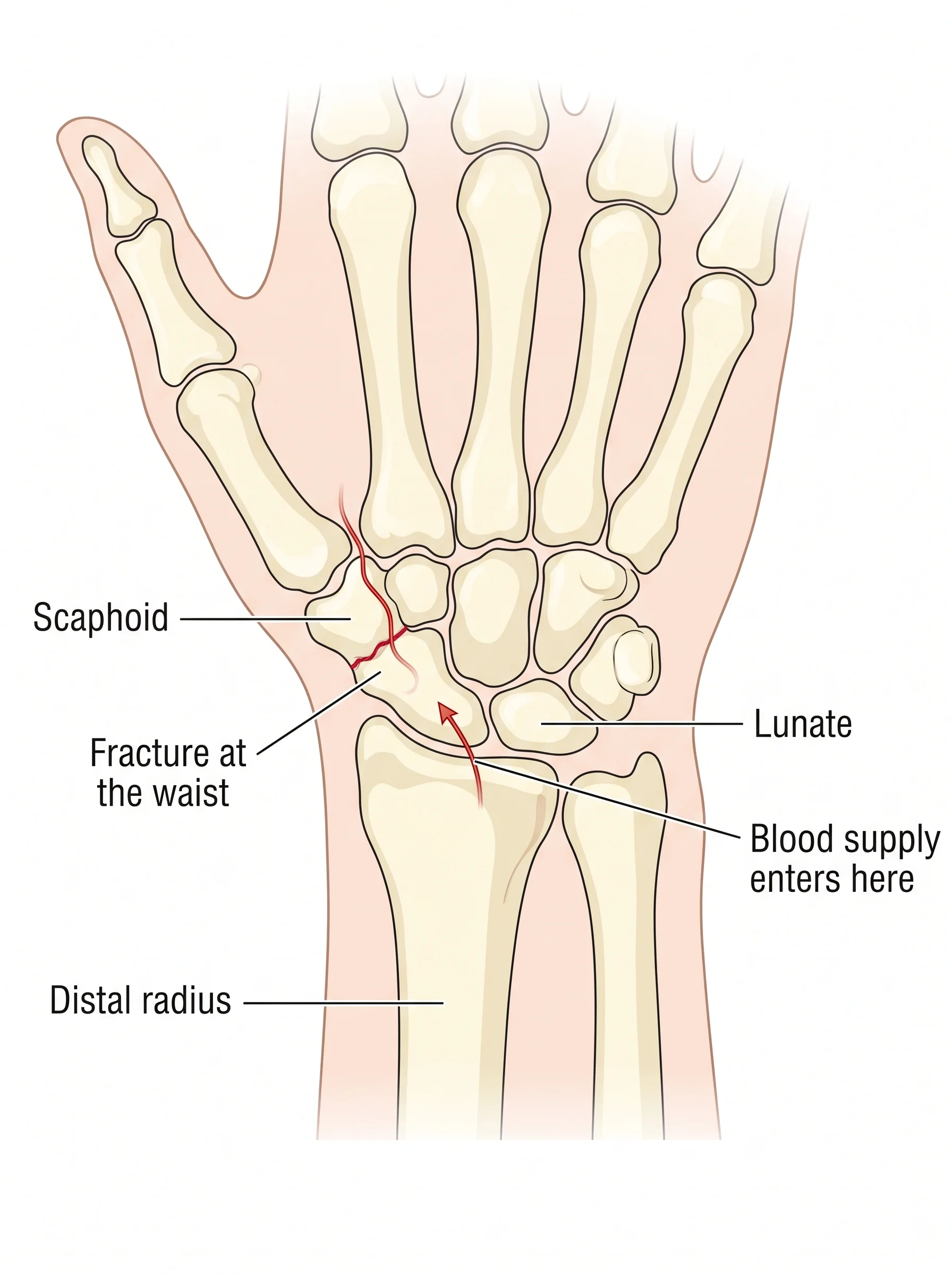
The scaphoid is a small wrist bone, about the size of a cashew, at the base of the thumb where the hand meets the forearm.
It carries a large share of the load when you catch yourself on your hand. A fall onto an outstretched hand, with the wrist bent back, is the usual cause.
Pain sits on the thumb side of the wrist. There is often swelling but little bruising, and the wrist still moves, so many people call it a sprain and wait.
Waiting matters more with this bone than most, because of how it is fed. Its blood supply enters near the thumb end and runs backward through the bone to the far end. A break across the middle can cut off the supply to the far piece. That piece may then heal slowly, heal crooked, or not heal at all, which is called a nonunion. A nonunion left alone for years wears out the wrist joint.
This is a reason to have a sore wrist checked again, not a reason to be alarmed. Found early and held still, most scaphoid fractures heal. A wrist that still hurts on the thumb side two weeks after a fall should be looked at again.
How is a scaphoid fracture diagnosed?
Pressing in the anatomic snuffbox, the small hollow on the thumb side of the wrist when the thumb is held out, reproduces the pain.
So does pressing the scaphoid tubercle, the bump at the base of the thumb on the palm side.
X-rays are taken with extra scaphoid views, since the bone hides behind its neighbors on standard films. A hairline crack often does not show for a week or two, so a normal film does not rule the injury out. When the exam points to the scaphoid and the film looks clean, the wrist is splinted and imaged again in about ten to fourteen days, or an MRI or CT scan is ordered sooner. A page cannot tell you which injury you have.
What is recovery like?
A fracture in good position near the thumb end commonly heals in six to eight weeks in a cast.
One through the middle, the waist, commonly takes eight to twelve weeks, and one at the far end can take longer. After surgery, a splint is worn briefly and motion starts early. Stiffness after time in a cast is normal and improves with hand therapy over weeks to months. According to general guidance from the American Academy of Orthopaedic Surgeons, healing time depends on where the break sits and how soon it was treated. These are ranges, not promises.
What are the treatment options?
- 01Ice, elevation, and a wrist splint while you arrange to be seenIce, elevation, and a wrist splint while you arrange to be seen
- 02A thumb spica cast, which holds the wrist and thumb still, for a fracture in good positionA thumb spica cast, which holds the wrist and thumb still, for a fracture in good position
- 03Repeat X-rays or a CT scan during casting to confirm the bone is knittingRepeat X-rays or a CT scan during casting to confirm the bone is knitting
- 04Hand therapy for stiffness and grip once the cast comes offHand therapy for stiffness and grip once the cast comes off
- 05Screw fixation for a fracture that has shifted, or one at the far end near the forearmScrew fixation for a fracture that has shifted, or one at the far end near the forearm
- 06Surgery with a bone graft for a fracture that has not healedSurgery with a bone graft for a fracture that has not healed
What do patients ask most?
My X-ray was normal but my wrist still hurts. What now?+
What happens if a scaphoid fracture is missed?+
Do I need surgery?+
Why does the cast include my thumb?+
Fellowship trained at Washington University, Barnes-Jewish Hospital - St. Louis, MO (Surgery of the Hand & Upper Extremity). Sees patients in Memphis.
About Dr. Cole →