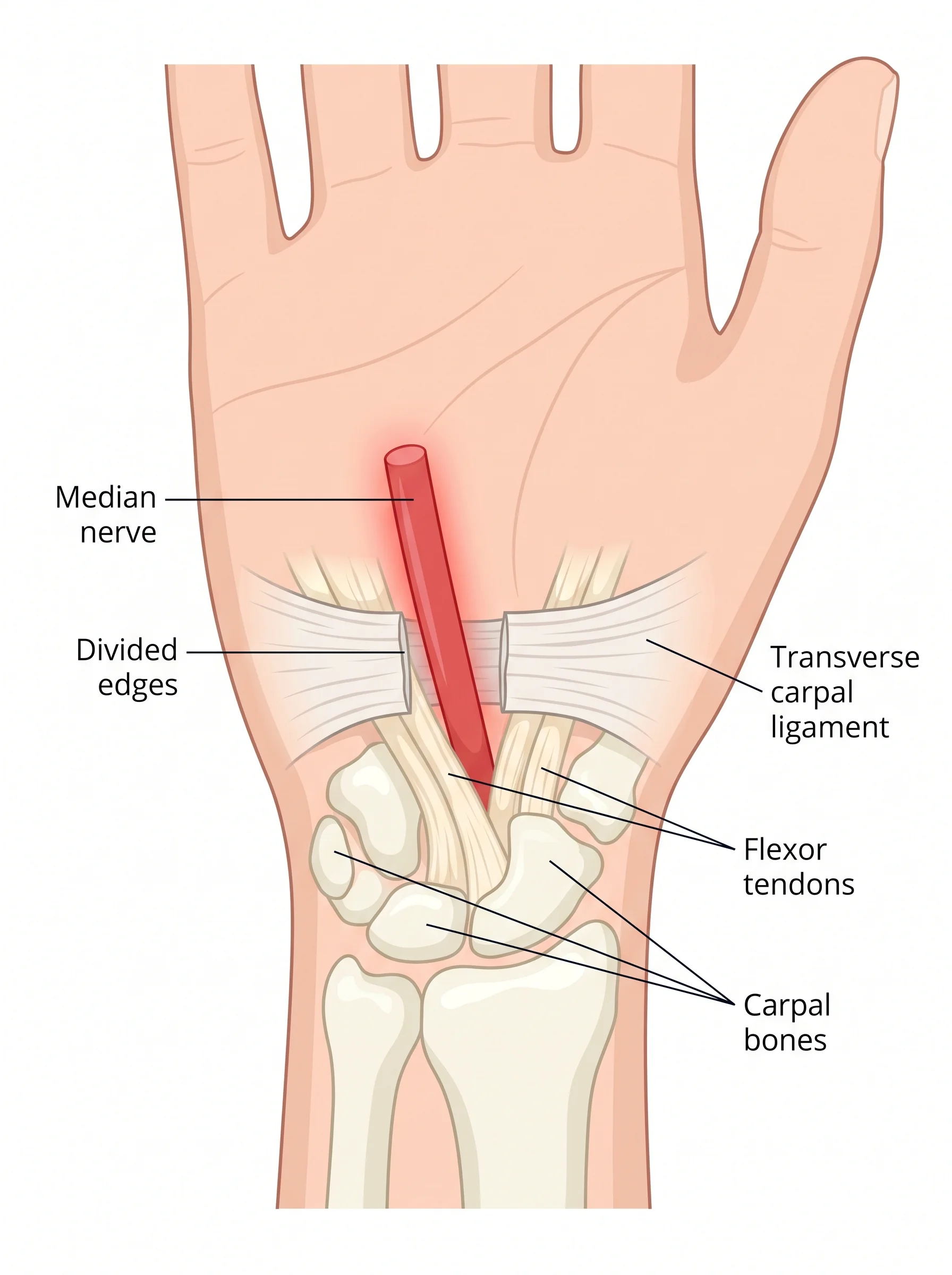
Carpal tunnel release is a small surgery that opens a tight ligament in the wrist to relieve pressure on the median nerve, the nerve that gives feeling to most of the hand. It is offered when hand numbness, tingling, or weakness does not improve with non-surgical care. Most people go home the same day.
Jeff Cole performs carpal tunnel release in Memphis when it is the right step, and reviews every alternative with you first.
What is Carpal Tunnel Release?
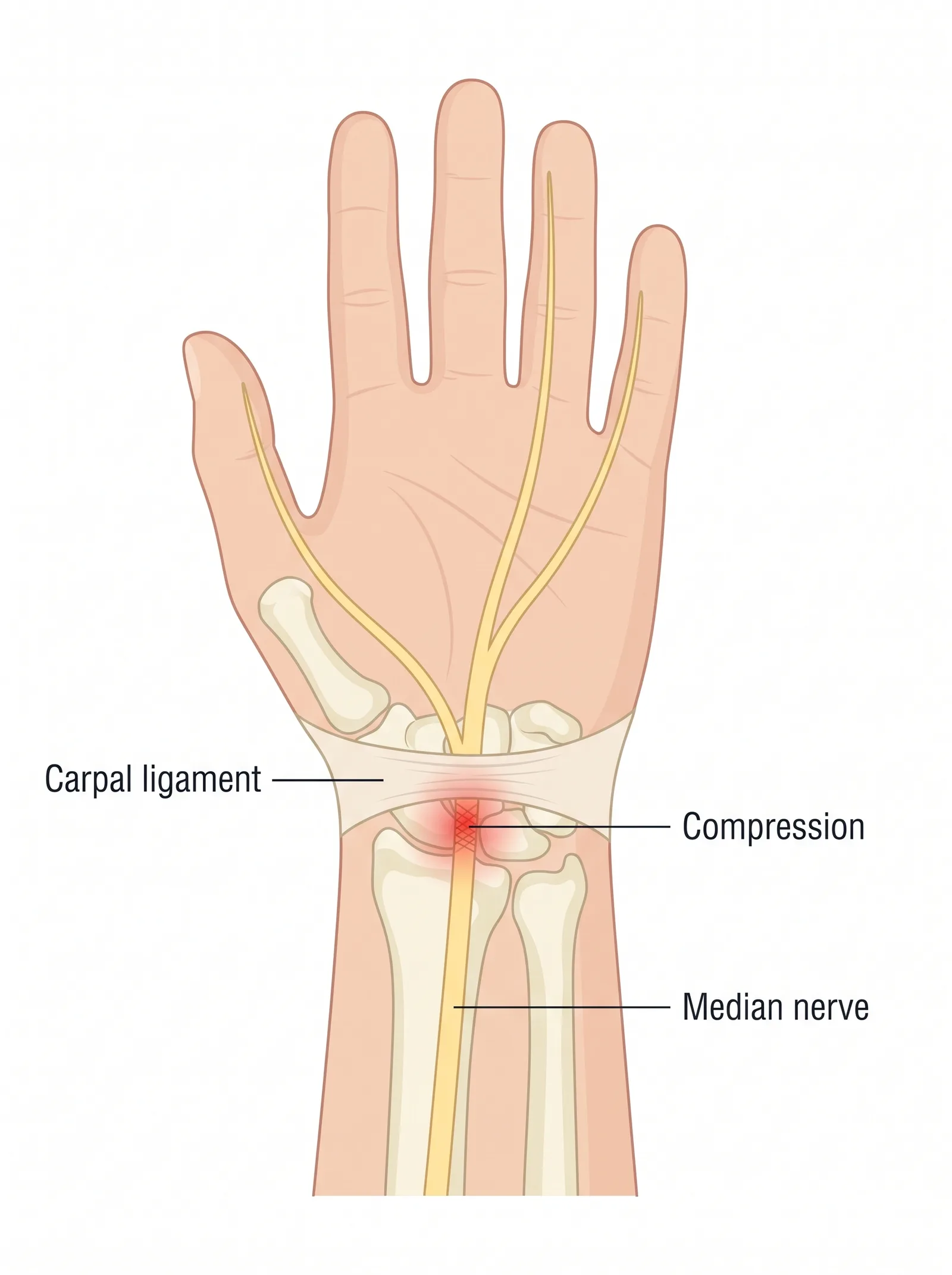
Carpal tunnel syndrome happens when the median nerve, one of the main nerves in the hand, gets squeezed as it passes through the wrist.
The nerve travels through a narrow space called the carpal tunnel. The floor and sides of this tunnel are wrist bones. The roof is a tough band of tissue called the transverse carpal ligament, sometimes called the flexor retinaculum. When the tissues in this tunnel swell, or the tunnel itself is naturally narrow, the nerve has less room. Pressure builds on the nerve, and the nerve stops sending clear signals.
Carpal tunnel release is the surgery that treats this. The word "release" means the surgeon cuts the transverse carpal ligament to make the tunnel larger. Once the ligament is divided, the pressure on the nerve drops right away. The ligament heals back over time in a slightly longer, looser position, so the extra room stays.
There are two common ways to do the surgery. Open carpal tunnel release uses one small cut in the palm. Endoscopic carpal tunnel release uses one or two smaller cuts and a tiny camera, called an endoscope, to guide the cutting from inside. Both methods divide the same ligament and aim for the same result. The choice depends on your anatomy, your symptoms, and what your surgeon does most often. You and Dr. Cole will talk through which approach fits you.
This is one of the most common hand surgeries done in the United States. It is usually short, and it is usually done while you are awake, with only the hand and wrist numbed.
What are the symptoms of Carpal Tunnel Release, and when should you see a specialist?
Carpal tunnel syndrome usually starts slowly.
Many people first notice it at night. Here is what patients often describe.
- Numbness or tingling in the thumb, index finger, middle finger, and half of the ring finger. The little finger is usually not affected, because a different nerve serves it. - A "pins and needles" feeling, or a sense that the hand has fallen asleep. - Waking up at night needing to shake the hand out to bring feeling back. - Trouble with small tasks, like buttoning a shirt, holding a phone, or turning a key. - Dropping things, or a feeling that the grip is weaker than it used to be. - Aching that can travel up the forearm.
Early on, the numbness comes and goes. Over time it can become constant. When the pressure has been high for a long time, the muscles at the base of the thumb can shrink, and the numbness may not fully come back even after treatment. That is why it helps to be seen before symptoms are severe.
It is reasonable to see a hand specialist when numbness or tingling in the hand happens most days, wakes you at night, or is starting to affect your work or daily tasks. If you notice the hand feeling weak, or if you drop things more than usual, that is a signal to be seen sooner rather than later. A specialist can tell carpal tunnel apart from other causes of hand numbness, such as a pinched nerve in the neck, and can measure how much the nerve is affected.
How is Carpal Tunnel Release diagnosed, and what does the visit involve?
The first visit is a conversation and an exam.
There is no single test that stands alone; the diagnosis comes from putting several pieces together.
History. Dr. Cole will ask when the symptoms started, which fingers are involved, what makes them better or worse, and how they affect sleep and daily life. Conditions like diabetes, thyroid problems, pregnancy, and past wrist injuries can all play a role, so those come up too.
Physical exam. The exam checks feeling in each finger, the strength of the thumb muscles, and the size of those muscles. Two gentle tests are common. In one, the surgeon taps over the nerve at the wrist to see if it sends a tingle into the fingers. In another, you hold your wrists bent for a short time to see if that brings on symptoms. These tests give clues but are not proof on their own.
Nerve testing. Many patients have a nerve conduction study and electromyography, often shortened to EMG. These tests measure how well and how fast the median nerve carries signals, and they show how much the nerve is affected. The testing also helps rule out other nerve problems. It involves small electrical pulses and thin needles, and most people tolerate it well.
Imaging. X-rays or ultrasound may be added if there is a question about arthritis, an old fracture, or swelling around the nerve. These are not always needed.
The goal of the visit is a clear answer: is this carpal tunnel syndrome, how much is the nerve affected, and what treatment fits you.
What happens during Carpal Tunnel Release, step by step?
Carpal tunnel release is usually an outpatient surgery, which means you go home the same day.
Here is the typical sequence.
Anesthesia. Most releases are done with local anesthesia, where only the hand and wrist are numbed, sometimes with light medicine to help you relax. Some patients have regional or general anesthesia. Your care team will explain which plan fits you and why.
Preparing the hand. The arm is cleaned and draped. A soft tourniquet may be placed on the upper arm to limit bleeding so the surgeon can see clearly.
The incision. In open release, the surgeon makes a small cut in the palm, usually about an inch or a little less, in line with the ring finger. In endoscopic release, one or two smaller cuts are made at the wrist crease, and a small camera is passed in to guide the work.
Dividing the ligament. The surgeon carefully identifies and divides the transverse carpal ligament. Cutting this band opens the roof of the tunnel and takes the pressure off the median nerve. The nerve itself is not cut. In open surgery the surgeon sees the ligament directly; in endoscopic surgery the camera provides the view.
Checking and closing. The surgeon confirms the ligament is fully divided and the nerve has room. The skin is closed with stitches. A soft dressing, and sometimes a light splint, is applied.
The surgical part is usually short. You will spend more time preparing and recovering than in the operation itself. Because the numbing medicine lasts a while, the hand often stays comfortable for the first several hours after you get home.
What is the recovery timeline for Carpal Tunnel Release?
Recovery is measured by what you can do, not only by the calendar.
The ranges below are typical, and they are ranges, not promises. General guidance from the American Academy of Orthopaedic Surgeons notes that night symptoms often improve quickly, while grip strength and full comfort in the palm take longer.
First days. Keep the hand elevated to limit swelling. You can usually move your fingers right away, and gentle finger motion is encouraged. Many people notice their night-time numbness is already better. Discomfort in the palm is common and is managed with the plan your team gives you.
Milestone: you can wiggle all fingers fully and the night tingling has eased.
First one to two weeks. Stitches are often removed around this time. Light use of the hand for everyday tasks like eating and writing is usually fine. The palm may feel tender, and the base of the palm can be sensitive when you press on it. This tenderness, sometimes called pillar pain, is normal and fades over weeks to months.
Milestone: stitches out, incision healing, using the hand for light daily tasks.
Two to six weeks. Grip and pinch strength gradually return. You slowly add more activity as comfort allows. People with desk jobs often return to work within days to a couple of weeks; people with heavy manual jobs may need longer. Dr. Cole will set your return-to-work timing based on your work and your progress.
Milestone: you can grip a cup, turn a doorknob, and do light work without sharp pain.
Six weeks to several months. Strength and full comfort in the palm continue to improve. Any numbness that was present before surgery may keep recovering over months, depending on how affected the nerve was to begin with. Scar sensitivity settles.
Milestone: near-normal grip and comfort for your usual activities.
Some people recover faster and some slower. Nerve recovery in particular can be gradual. Steady progress matters more than hitting an exact date.
Read the full guide to preparing for surgery →
Your own recovery instructions come from the office and are specific to you. This page describes the general course, not a plan to follow.
How should you prepare for surgery?
A little planning makes the day and the first week smoother.
Transportation. Arrange a ride home. Even with local anesthesia, you should not drive yourself right after surgery, and if you receive sedation you will need someone with you.
Home setup. Set up things you will use often within easy reach, so you are not gripping or lifting with the healing hand. Loose sleeves that fit over a dressing help. Prepare a few easy meals ahead of time, since one hand will be limited for a bit.
Time off. Plan time off based on your job. Desk workers often need only a short break; those who do heavy or repetitive hand work usually need more. Ask the office for a realistic estimate for your situation.
Who to have available. It helps to have someone available for the first day for driving and small tasks that need two hands, like opening jars or cutting food.
Medicines and health. Tell the office about all medicines and supplements you take, especially blood thinners. Follow the instructions you are given about which to pause and which to continue. If you smoke, know that it can slow healing; the office can talk with you about this.
Questions before the day. Write down your questions ahead of time. Anything about insurance or coverage is answered by the office.
Which warning signs should you call about?
Most recoveries are smooth, but call the office if you notice any of the following.
- Fever, or spreading redness, warmth, or drainage from the incision. These can be signs of infection. - Pain that is getting worse instead of better, especially if it is severe or not helped by your usual plan. - Numbness that is suddenly worse, or new numbness, after it had been improving. - Fingers that look pale, blue, or feel cold. - A dressing that feels too tight, or swelling that keeps increasing despite elevation. - Any concern that does not feel right to you.
Who to call: reach out to the office of Jeff Cole at (901) 621-7091 during office hours (). If you have chest pain, trouble breathing, or another emergency, call 911 or go to the nearest emergency room. When in doubt, it is always fine to call and ask.
What results can you expect from Carpal Tunnel Release?
Carpal tunnel release has a long track record.
Here is what the evidence generally shows, with sources named. These are ranges, not promises.
According to general guidance from the American Academy of Orthopaedic Surgeons, most patients have relief of their numbness and tingling after surgery, and night symptoms in particular tend to improve early. The same general guidance notes that people whose nerve was severely affected for a long time before surgery, including those with muscle wasting, may have some lasting numbness or weakness even after a well-done release, because the nerve can be slow or incomplete in recovering.
Reviews of surgical studies have generally found that open and endoscopic techniques lead to similar long-term relief, with the main differences being in the very early recovery period rather than the final result. Because study methods differ, exact numbers vary from report to report, which is why we describe results as ranges.
Complications are uncommon but possible with any surgery, and can include infection, ongoing palm tenderness, incomplete relief, and, rarely, nerve irritation. Dr. Cole will review the specific benefits and risks for your situation before you decide.
The honest summary: this is a reliable operation for the right patient, most people are glad they had it, and the biggest factor in how much feeling returns is often how much the nerve was affected before surgery.
What are the treatment options?
- 01Night splintsA wrist splint holds the wrist straight while you sleep. A bent wrist raises pressure in the tunnel, so keeping it straight at night can ease symptoms. Many people feel a difference within a few weeks.
- 02Activity changesAdjusting how you use the hand can help, especially with tasks that keep the wrist bent or that involve strong repeated gripping. Small changes to a workstation, tools, or the way you hold a phone can lower the load on the nerve.
- 03Steroid injectionA corticosteroid injection places anti-inflammatory medicine near the tunnel to reduce swelling around the nerve. Relief can last weeks to months. For some people the benefit is lasting; for others it fades, but even temporary relief can help confirm the diagnosis.
- 04Treating related conditionsBecause thyroid problems, diabetes, and other issues can contribute, managing those can help the hand.
What do patients ask most?
Will the numbness go away completely?+
How long until I can drive?+
Will I need physical therapy?+
Is one incision method better than the other?+
Can carpal tunnel come back?+
Will there be a scar?+
Do I have to stay overnight?+
Fellowship trained at Washington University, Barnes-Jewish Hospital - St. Louis, MO (Surgery of the Hand & Upper Extremity). Sees patients in Memphis.
About Dr. Cole →