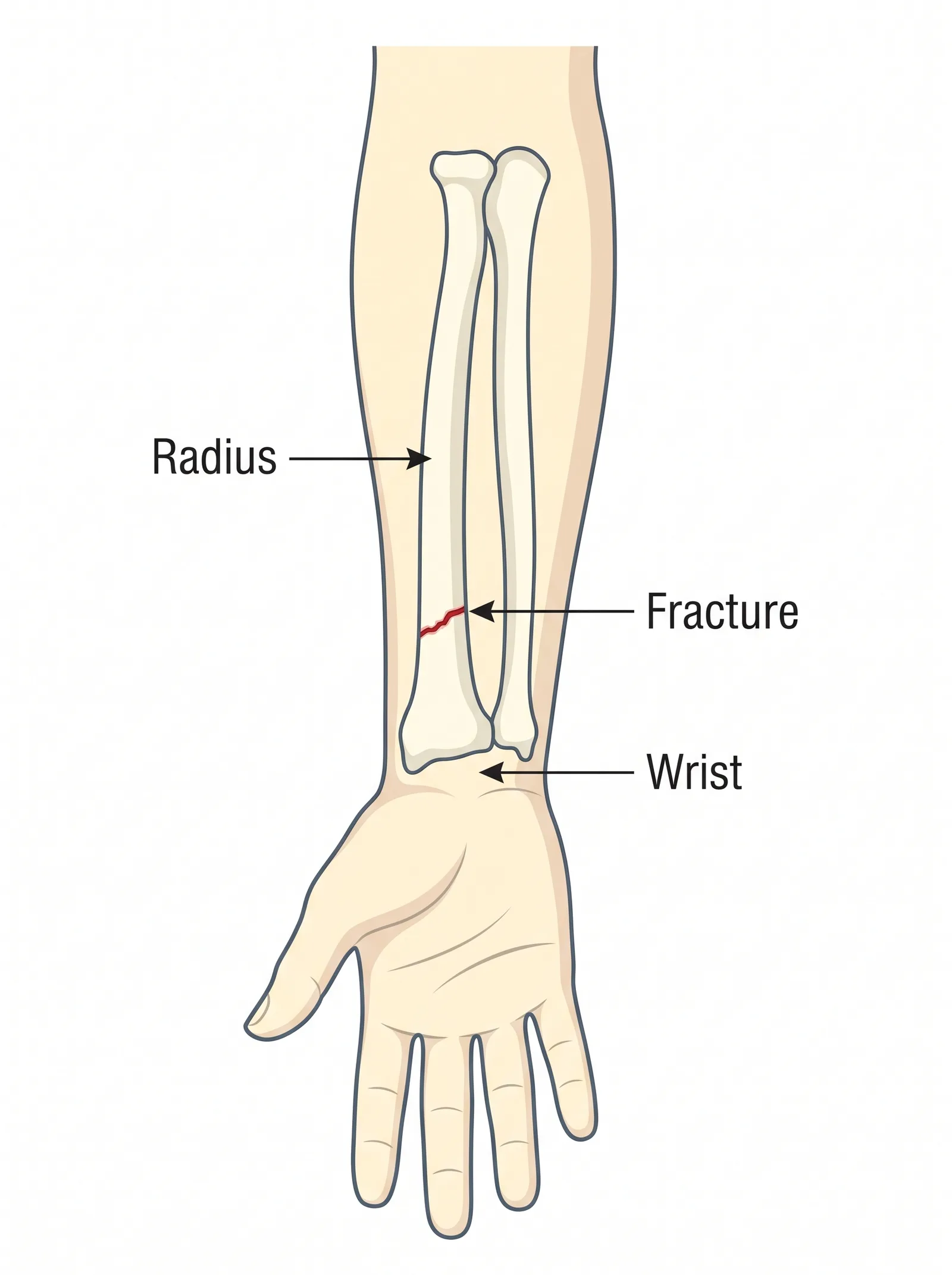
A distal radius fracture is a break of the larger forearm bone near the wrist, often from a fall onto an outstretched hand. Many heal well in a cast, while some need a procedure to line the bone up and hold it. Care depends on how the bone broke and your daily needs.
Jeff Cole diagnoses and treats distal radius (wrist) fracture in Memphis, from the first visit through recovery.
What is Distal Radius (Wrist) Fracture?
A distal radius fracture is one of the most common broken bones.
The radius is the larger of the two forearm bones. The word distal means the end nearest the hand, so a distal radius fracture is a break near the wrist. Because we naturally put a hand out to catch ourselves, this bone often takes the force of a fall, and it breaks.
There are many patterns. The bone may crack in a simple, stable line, or it may break into several pieces. The broken end may stay in a good position, or it may shift, tilt, or shorten. Sometimes the break reaches into the wrist joint itself, which involves the smooth cartilage surface. Sometimes the smaller forearm bone, the ulna, is injured too. The pattern of the break is what guides treatment.
These fractures happen across all ages. In younger people they often come from higher-force injuries, such as a sports fall or a bike crash. In older adults they can happen with a simple fall, in part because bone can thin with age, a condition called osteoporosis. If you are older and break this bone from a low-energy fall, the office may suggest a check of bone health to help prevent future fractures.
The goal of treatment is a wrist that heals in good alignment so it can move well and hold up to daily use. Many fractures heal well without surgery. Others need a procedure to line up and secure the bone. This page explains both paths. For a shorter overview, see our wrist fracture service page, which links back to this full guide.
What are the symptoms of Distal Radius (Wrist) Fracture, and when should you see a specialist?
A distal radius fracture usually announces itself.
Common signs right after the injury include the following.
- Immediate pain in the wrist, often severe, after a fall or blow. - Swelling and tenderness around the wrist. - Bruising that develops over hours. - A wrist that looks bent, crooked, or out of shape. - Trouble moving the wrist or gripping. - Numbness or tingling in the fingers, which can mean a nerve is irritated.
A wrist fracture is usually an urgent problem, not one to watch at home for weeks. If you have severe pain, an obvious deformity, or numbness in the hand after a fall, seek care promptly, often at an urgent care or emergency department, where an X-ray can be taken. Signs that need immediate emergency care include a bone that breaks the skin, a hand that is pale or cold, or numbness that is getting worse quickly. After the first evaluation, a hand and wrist specialist can guide the rest of care.
How is Distal Radius (Wrist) Fracture diagnosed, and what does the visit involve?
Diagnosis centers on an exam and X-rays.
Dr. Cole will ask how the injury happened, since the force and mechanism suggest the break pattern, and will ask about your hand use, your health, and your goals.
The exam is done gently to avoid extra pain. Dr. Cole checks the shape of the wrist, the skin, the circulation to the hand, and the feeling and movement of the fingers. Checking the nerves matters, because a shifted fracture can press on the median nerve and cause numbness like carpal tunnel syndrome.
X-rays are the main test. They show which bone broke, how many pieces there are, whether the break enters the joint, and how the pieces are positioned. In more complex breaks, a CT scan, which is a detailed set of X-ray images, may be ordered to map the joint surface and plan treatment. The office will explain what the images show and what it means for your care.
What does treatment for Distal Radius (Wrist) Fracture involve?
When surgery is needed, the goal is to line up the bone, including the joint surface, and hold it steady so it heals in a good position.
Here is the usual sequence.
Before the day. You and Dr. Cole review the X-rays or CT scan and decide on surgery together. The office checks your health, medicines, and blood thinners, and explains fasting instructions. Insurance questions are answered by the office.
Anesthesia. Surgery is done with regional anesthesia, which numbs the arm, general anesthesia, which puts you fully asleep, or a combination. The team will discuss what fits you.
Aligning the bone. Dr. Cole moves the broken pieces back into their correct position, restoring the length, tilt, and joint surface of the radius. For breaks into the joint, care is taken to make the cartilage surface as smooth and even as possible.
Fixing the bone. The most common method is a plate and screws, often placed through an incision on the palm side of the wrist. The plate acts like an internal splint that holds the pieces while they heal. In some patterns, pins, an external frame, or other devices are used instead. Dr. Cole will explain the method chosen for your break.
Closing. The incision is closed and a splint is applied. Most of these surgeries are outpatient, so you go home the same day, though some situations need a short stay.
Right after. You rest in recovery while the anesthesia wears off. Because the arm is numb and splinted, arrange a ride home. Keeping the hand raised helps limit swelling.
What is the recovery timeline for Distal Radius (Wrist) Fracture?
Recovery is measured by healing milestones, not just the calendar.
Bone healing takes time, and motion and strength return gradually after that. The ranges below are typical. According to general guidance from the American Academy of Orthopaedic Surgeons, wrist fractures commonly take several weeks for the bone to heal, with motion and strength continuing to improve for months, and some recovery continuing up to a year. These are ranges, not promises.
Week 0 to 2 (protect and settle). The wrist is protected in a splint or cast. You keep the hand raised to reduce swelling and move the fingers, elbow, and shoulder to keep them from stiffening. The milestone is settling pain and swelling with the fingers moving.
Week 2 to 6 (early healing). The bone is knitting. With surgery and a plate, therapy and gentle wrist motion often start earlier. Without surgery, the cast usually stays on during this window. The milestone is comfortable healing confirmed on follow-up X-rays.
Week 6 to 12 (motion and light use). As the bone becomes solid, the cast or splint comes off and hand therapy focuses on regaining wrist motion. You begin light use of the hand. The milestone is improving motion and the ability to do light daily tasks.
Month 3 to 6 (strength). Therapy adds strengthening. Grip and wrist strength build, and you return to more demanding activities. The milestone is a stronger, more capable wrist.
Month 6 to 12 (full recovery). Motion, strength, and comfort can keep improving for up to a year, especially after more complex breaks. The milestone is a wrist that meets your daily needs.
Return to work depends on the job and the break. Desk work may resume within a week or two, especially after plate fixation. Heavy manual work can take several months. The office will plan a realistic return.
How should you prepare for the visit or procedure?
If you are heading toward surgery, planning helps.
Transportation. Arrange a ride home after any procedure and for early follow-up visits, since the arm will be splinted.
Home setup. Prepare one-handed solutions: easy-on clothing, slip-on shoes, pre-made meals, and daily items within reach. Set up a comfortable spot to rest with the arm raised.
Time off. Plan time based on your job and whether you have surgery. Discuss your specific work with the office.
Who to have available. Have someone available for the first days to drive and help with two-handed tasks and dressings.
Health steps. Follow guidance on medicines, blood thinners, and fasting before surgery, and share a full list of what you take. If the fracture came from a low-energy fall and you are older, ask the office about a bone-health check to lower future fracture risk. If you smoke, cutting back supports bone healing.
Which warning signs should you call about?
Call the office at (901) 621-7091 during for any of these.
- Fingers that are numb, tingling, pale, blue, or very cold, or a splint or cast that feels too tight. - Pain that keeps getting worse despite rest, elevation, and your pain plan. - Fever, spreading redness, warmth, or drainage at an incision, which can signal infection. - A cast that gets wet, cracked, or loose, or a wound that keeps bleeding. - New numbness in the hand that is getting worse.
Numbness that worsens quickly, a hand that turns pale or cold, or severe, uncontrolled pain can be an emergency. If you cannot reach the office, seek emergency care. It is always fine to call and ask.
What results can you expect from Distal Radius (Wrist) Fracture?
Most people recover good use of the wrist after a distal radius fracture.
According to general guidance from the American Academy of Orthopaedic Surgeons, outcomes are generally good when the bone heals in proper alignment, whether treated in a cast or with surgery, and the method is chosen to fit the fracture and the person. These are ranges, not promises.
A few honest points help set expectations. Complex breaks, breaks into the joint, and injuries in older adults with thinner bone can take longer and may leave some stiffness or aching, especially with weather changes or heavy use. Hand therapy plays a large role in the final result. Dr. Cole will talk with you about the likely outcome for your specific break and your goals.
What are the treatment options?
- 01Casting or splintingIf the bone is in a good position, or can be gently moved into one, a cast or splint holds it while it heals. Bone heals well when it is held still in good alignment.
- 02Closed reductionIf the broken end has shifted, Dr. Cole may perform a closed reduction, which means guiding the bone back into place without surgery, usually after numbing the area. A cast or splint then holds the position. Repeat X-rays check that the alignment stays good as swelling goes down.
- 03MonitoringDuring cast treatment, follow-up X-rays make sure the bone has not shifted. If alignment holds, healing continues in the cast. If the bone slips out of position, surgery may be reconsidered.
- 04Pain control and motionSimple pain measures and early motion of the fingers, elbow, and shoulder keep the rest of the arm from getting stiff while the wrist heals.
What do patients ask most?
Do I need surgery for a broken wrist?+
How long will I be in a cast?+
When can I drive?+
Will my wrist be as good as before?+
Why check my bone health?+
Fellowship trained at Washington University, Barnes-Jewish Hospital - St. Louis, MO (Surgery of the Hand & Upper Extremity). Sees patients in Memphis.
About Dr. Cole →