Why this one small wrist bone heals unlike any other: a blood supply that enters from the far end, an X-ray that can read normal while the bone is broken, what a missed break does to the wrist over years, and how the choice between a cast and a screw is actually made.
Jeff Cole diagnoses and treats scaphoid fracture in Memphis, from the first visit through recovery.
Why does this one small bone heal so differently from the others?
Most bones are fed from several directions.
The scaphoid is built the other way around.
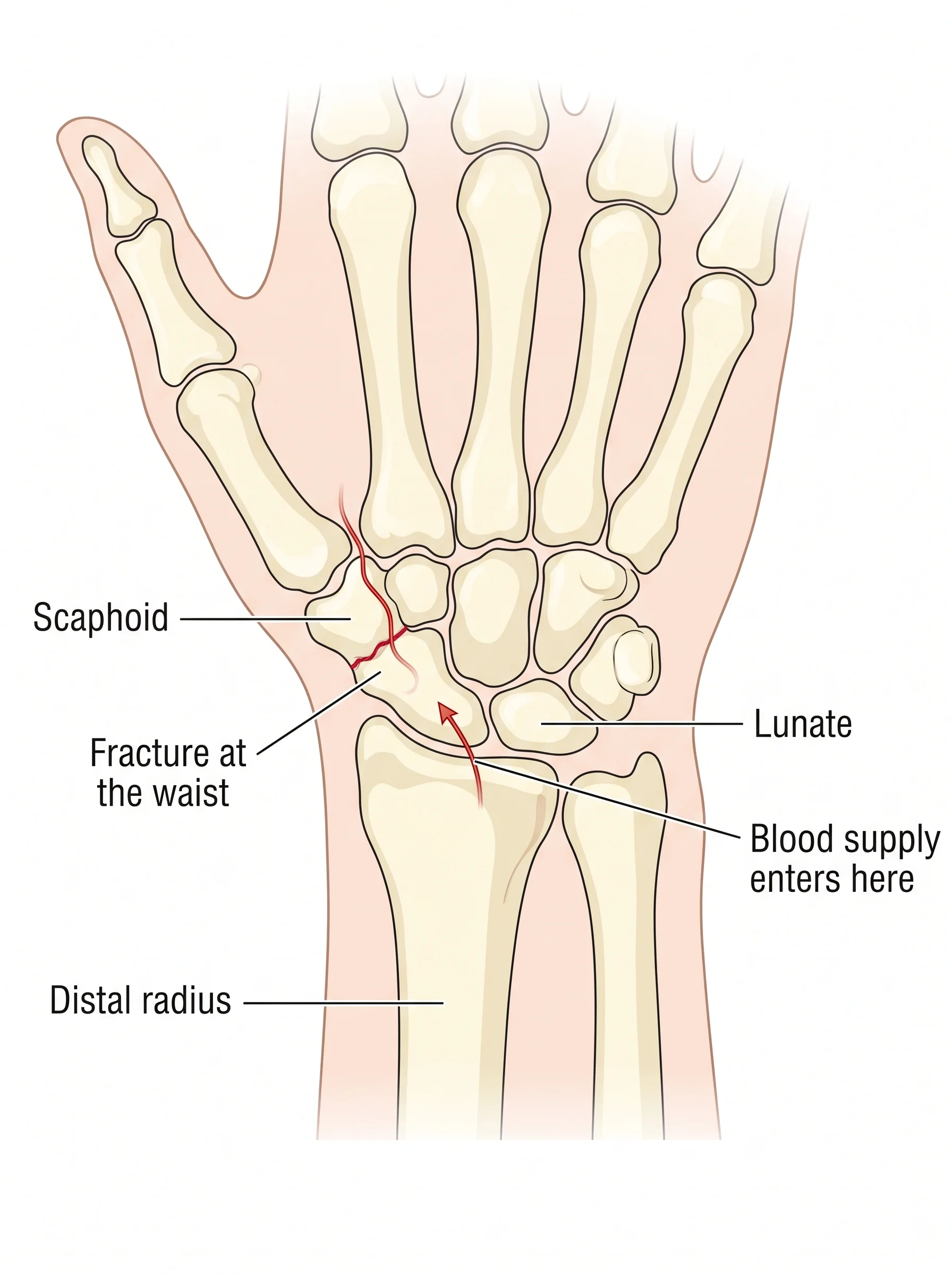
Almost all of its surface is covered in cartilage, because it forms part of several joints at once. Cartilage has no blood vessels, and there is very little room left for the thin covering layer that normally carries them. So the blood has to come in through one small area, a ridge on the back of the bone near the thumb end. From there the vessels run backward through the bone, toward the far end nearest the forearm. That end, the proximal pole, is the last place the blood reaches.
Break the bone across its middle, at the waist, and you cut that supply line. The near half still has its vessels. The far half may be left with very little. If a fracture runs through the proximal pole itself, the piece beyond it can be almost entirely cut off. Bone with no blood supply cannot repair itself, and if the supply is poor it can die, which is called avascular necrosis.
There is a second reason it is slow. With no covering layer to speak of, the scaphoid does not heal by throwing a cuff of new bone around the break the way a forearm bone does. It has to knit from the inside, directly across the fracture line. That kind of healing needs the two pieces held completely still and touching, and it takes time. Put those two facts together and the long cast times make sense.
Why can the first X-ray be normal when the wrist is broken?
An X-ray does not show a crack.
It shows a change in density. A fracture becomes visible when the two pieces have moved apart, or when the bone right along the fracture line has been reabsorbed by the body, which opens up a dark line. In a break where nothing has shifted, there may be nothing dark to see on day one. A week or two later, as that reabsorption happens, the same fracture appears.
The shape and position of the bone make it worse. The scaphoid is small, angled rather than flat, and surrounded by seven other bones that overlap it on a standard picture. Special scaphoid views, taken with the wrist tipped and the beam angled, help but do not solve it.
This is why the phrase clinical scaphoid fracture exists. It means the story and the examination point to the bone, the film does not show a break, and the wrist is treated as broken until proven otherwise. Guidance from both the American Academy of Orthopaedic Surgeons and the American Society for Surgery of the Hand supports splinting a wrist with snuffbox tenderness and a normal film, then repeating the imaging rather than sending the person away.
What happens next varies sensibly. Some wrists are splinted and re-X-rayed in about ten to fourteen days. Some go straight to MRI, which shows the bruising and swelling inside the bone within days of the injury and is the most sensitive early test. Some go to CT, which shows the bone in fine detail and answers whether the pieces have shifted. A page cannot tell you whether your own wrist is broken, which is why a tender wrist is treated as though it might be.
What happens over the years if it is missed?
A fracture that never heals is called a nonunion.
The two pieces stay separate, joined by soft fibrous tissue instead of bone, and they move against each other slightly with every wrist movement.
Underneath, the mechanics have changed. The scaphoid normally works as a strut, tying the two rows of wrist bones together and controlling how they move as a unit. When it is broken in two, the near piece tips forward and the far piece follows the row it belongs to. The bone gradually collapses into a bent shape, and the wrist bones behind it rotate out of line. The load that used to be spread over broad, well matched surfaces now lands on small patches.
Cartilage wears where the load concentrates, and it does so in a recognized order. The first place is the tip of the radius on the thumb side, where the shifted fragment grinds against it. Then the wear spreads across the joint between the scaphoid and the forearm bone. Later it reaches the joint in the middle of the wrist. The corner where the forearm meets the lunate is usually the last to go, which is what keeps reconstructive operations possible even late.
This pattern has a name, scaphoid nonunion advanced collapse. It is slow, often taking a decade or more, and it does not happen to everyone. It is predictable enough to be worth avoiding, and that is the whole argument for chasing down a sore wrist after a fall rather than waiting to see.
Cast or screw: how is that decision actually made?
Two facts about the fracture do most of the deciding.
The first is whether the pieces have moved. Any gap, step, or angulation between them means the bone is unlikely to knit in a cast, and fixation is advised. The second is where the break sits. A fracture through the proximal pole, the end with the poorest blood supply, is generally fixed, because the odds of it healing in a cast are low and the cost of finding that out after three months is high.
For the common fracture, a crack through the waist with nothing displaced, both options are genuinely reasonable and the conversation is about trade offs. A cast avoids an operation and its risks, and most of these fractures unite. Surgery, usually a small screw placed through a short incision or through a puncture with X-ray guidance, means much less time immobilized and an earlier return to work and sport. Against that sit the ordinary risks of an operation: infection, nerve irritation, a screw that sits proud, and the small chance of needing a second procedure.
Your own circumstances count here more than usual. Time since the injury matters too, since a fracture found late has already lost some of its chance to heal simply.
What is life in a thumb spica cast actually like?
The cast holds the wrist and the thumb, leaving the fingers free and usually the elbow too, so that the two pieces of bone cannot move against each other.
The practical business of it is what nobody warns you about. Washing is awkward and the cast has to stay dry, so a plastic sleeve for showers is worth buying on day one. Skin under a cast itches, and the rule is to resist pushing anything down inside it, because a scratch you cannot see can become an infection you cannot treat. The forearm muscles shrink visibly over the weeks. All of that is expected and reverses.
What you should do is keep everything that is free moving. Fingers, elbow, and shoulder stiffen quietly inside a few weeks of disuse, and that stiffness takes longer to undo than the fracture takes to heal. Make a full fist and straighten the fingers fully, several times a day, every day.
Two things surprise people at the follow up visits. The first is that the wrist can feel completely fine long before the bone has united, which is why the cast stays on until imaging says otherwise and not until the pain stops. The second is that plain X-rays through a cast can be hard to read, so a CT scan is often used to decide whether the bone has actually knitted. Being told at eight weeks that it needs longer is disappointing, and not a sign that anything has gone wrong.
What can be done for a break that never healed?
Quite a lot, and the plan depends on two things: the shape of the bone and whether the far fragment still has a blood supply.
The basic operation clears the fibrous tissue from between the fragments, restores the bone to its proper length and shape, fills the gap with a graft of bone, and holds it all with a screw. The graft is usually taken from the far end of the same forearm through the same incision, or from the pelvis when a larger piece is needed.
When the far fragment has lost its blood supply, plain graft has a harder job. The answer there is a graft that brings its own blood supply with it, either swung across from the back of the forearm on its own small vessels, or taken from the thigh bone and joined to vessels at the wrist under a microscope. These are longer operations done in selected cases, and they exist precisely because of the backward blood supply described earlier.
Two honest points. Healing after nonunion surgery is less certain than after a fresh fracture and takes longer, commonly three months or more in a cast or splint, and sometimes it does not work at first attempt. And if the joint has already worn out, repairing the scaphoid no longer helps. At that stage the conversation shifts to operations that remove the worn surfaces and accept some loss of motion in exchange for comfort, which is covered under wrist arthritis.
What makes healing more likely, and what works against it?
Time is the first factor.
A fracture treated in the days after the injury has the greatest chance of straightforward healing. A fracture found at three months has already spent that time moving, and the fragment ends have started to smooth over.
Position is the second, along with location, for the blood supply reasons already covered. Pieces that are touching and lined up can knit. Pieces separated by a gap cannot, no matter how long the cast stays on.
Then there are the things you have some control over. Nicotine in any form, including cigarettes, vaping, and patches, is well recognized to slow bone healing, and this is the fracture where surgeons will ask about it most insistently. Stopping, even for the healing period, is worth more here than almost any other single measure. So does actually keeping the cast on, however tempting it is to take it off for a shower.
Some things are outside anyone's control, and it is fair to say so. Two people with what look like identical fractures, treated identically, can heal at different rates for reasons nobody can identify. A fracture that fails to unite is not usually a sign that somebody did something wrong.
Repeat imaging is how all of this is tracked, and it is the reason follow up appointments are not optional in this injury. A break that is not progressing is better found at ten weeks than at ten months.
What do the months after the cast comes off feel like?
The first sight of the wrist is a shock for most people.
It looks thin and feels stiff enough that turning a doorknob is a project, and that is the cast rather than the bone.
Motion comes back first, usually over several weeks of daily gentle bending, straightening, and turning of the forearm. Hand therapy is worth it if the stiffness is more than mild, and it becomes important after a long period of immobilization or after surgery for a nonunion. Grip strength is the slowest to return and commonly takes two to three months to feel useful again, longer for heavy work.
Some aching with heavy use, cold weather, or push up positions is common in the first months and usually settles. Pain that is getting worse rather than better, or a wrist that stays swollen and weak, is worth reporting rather than pushing through.
After fixation, the pattern is different. A splint is worn briefly, motion often starts within a week or two, and light use returns early, though loading through the palm waits until imaging shows the bone united.
According to general guidance from the American Academy of Orthopaedic Surgeons, healing time depends on where the break sits and how soon it was treated, and the follow up is what confirms it. These are ranges, not promises.
What are the treatment options?
- 01Splint the wrist and be assessed, before any decision, when the snuffbox is tender after aSplint the wrist and be assessed, before any decision, when the snuffbox is tender after a fall
- 02Repeat imaging, with X-ray, CT, or MRI, when the first film is normal but the examinationRepeat imaging, with X-ray, CT, or MRI, when the first film is normal but the examination is not
- 03A thumb spica cast for a fracture that has not shifted, with imaging during treatment to cA thumb spica cast for a fracture that has not shifted, with imaging during treatment to confirm it is knitting
- 04Hand therapy for stiffness, grip, and forearm strength once the cast is offHand therapy for stiffness, grip, and forearm strength once the cast is off
- 05Screw fixation for a fracture that has shifted, one at the far end, or one where a long caScrew fixation for a fracture that has shifted, one at the far end, or one where a long cast will not work
- 06Surgery with a bone graft, sometimes carrying its own blood supply, for a fracture that haSurgery with a bone graft, sometimes carrying its own blood supply, for a fracture that has not healed
- 07Salvage surgery such as proximal row carpectomy or four corner fusion once the joint has wSalvage surgery such as proximal row carpectomy or four corner fusion once the joint has worn out
What do patients ask most?
Can I drive with a thumb spica cast on?+
Why do I need a CT scan when my wrist already feels fine?+
Does the screw ever have to come out?+
Can I play sport in the cast?+
Is a bone stimulator worth trying?+
Fellowship trained at Washington University, Barnes-Jewish Hospital - St. Louis, MO (Surgery of the Hand & Upper Extremity). Sees patients in Memphis.
About Dr. Cole →